
Can you name one mistake you fixed the last time you tried to practise English speaking with ChatGPT? If you cannot, the session did not fail you. The default setup did. Change the assistant’s job before you speak: tell it once to keep replies to two sentences, stop after every answer you give, name exactly one mistake, show the sentence a fluent speaker would use, and make you say it again. Then talk for two minutes about something real, save that one correction as a single line, and paste the line back tomorrow. That is the whole method.
Why a normal ChatGPT chat fixes nothing
Out of the box, ChatGPT is a conversation partner, not a coach. It answers what you meant rather than how you said it, keeps the topic moving with follow-up questions, and writes longer turns than you speak. Twenty friendly minutes can pass in which you produced less English than the machine did.
The praise is not bad luck either. In 2025, OpenAI withdrew a GPT-4o update it described as “overly flattering or agreeable”; its own explanation, quoted in full here, says the update “focused too much on short-term feedback” and “skewed towards responses that were overly supportive but disingenuous”. The behaviour has a name in research. Sharma and colleagues write that “human feedback may also encourage model responses that match user beliefs over truthful ones, a behaviour known as sycophancy“. Expect flattery by default, and instruct it away.
Correction itself is not the problem. A 2023 review of corrective feedback research concludes that “following decades of CF research, there has been a consensus that CF is beneficial to L2 learning“. A general assistant simply does none of the four things a coach does unless you ask, which is the mechanism behind how an AI speaking coach works.
Set it up once before you speak
The setup is one block of text and three decisions. Do it before you open your mouth, because the instruction has to be in the chat before your first sentence, not after it.
- Open a new chat and decide where the instruction lives. At the time of writing, checked on 27 September 2026, we could not confirm on OpenAI’s own pages whether custom instructions apply to voice conversations or which plans include them, so paste the block at the start of each chat. That always works.
- Fill in the three brackets: your first language, the English variant you want, and your rough level.
- Paste the block, then run the 30-second check in the next section before you trust it.
- Keep the filled-in version in a note you can reach in one tap.
You are my English speaking coach. Follow these rules in every reply.
- Reply in no more than two sentences, so I do most of the talking.
- After each of my answers, stop and name exactly ONE mistake. Never more.
- Label it either "wrong" or "correct but not natural".
- Give me the sentence a fluent speaker would use.
- Explain it in one line in [my first language].
- Ask me to say the corrected sentence again before we continue.
- Do not praise my English and do not compliment me.
- If there was no mistake, say "no mistake" in three words and ask your next question.
- Use [American or British] English. My level is roughly [level].
The word most competitor prompts get wrong is “all”. Ask for every mistake and you get a report card with six fixes, which is more than attention holds: working memory’s focus of attention “averages about four chunks in normal adults”. One named mistake, repeated aloud, is the one point per session design rule behind Two-Minute Speaking, the app this site publishes and a competitor for your practice time. We give the rule away because it works in any tool.
Two lines in that block do work almost no published prompt does. The label separates “wrong” from “correct but not natural”, because a sentence can be grammatical and still not be what a fluent speaker would say. The explanation line asks for one sentence in your own first language, which shortens the explaining and lengthens the speaking. Both work for any language you speak.
How do you stop it saying everything was great
Say “do not praise my English” explicitly, then test that the instruction took. The check costs thirty seconds: speak one sentence you know is wrong, such as “I have problem with my manager”, and see what comes back. A working setup names the missing article and hands you “I have a problem with my manager” to repeat. A setup that answers your manager problem and calls your English excellent has not taken.
If the praise returns mid-session, paste the block again and end the session earlier. We cannot show you a source proving that long chats bury an instruction, so treat that as practical advice rather than a finding.
Tip
Keep the filled-in block in a pinned note on your phone. Practice should cost one paste, not one act of memory.
Voice mode or typing
Both channels work with the same block. They train different things, so choose deliberately rather than by mood.
| Channel | What it trains | What it misses | When to use it |
|---|---|---|---|
| Voice mode | Building a sentence in real time, out loud, with no edit key | Your exact words, unless a transcript is shown; fine pronunciation judgement | Most sessions, because it is the skill you actually need |
| Typing | Word choice and sentence shape at your own pace | The time pressure that makes you stall in a real conversation | Late at night, in a shared office, or on a day your voice is gone |
Voice mode is the default choice, with one habit attached: read what it heard. Speech recognition is strong but not perfect on non-native English. A 2025 benchmark found the best systems reached “mean Match Error Rates of 0.054 and 0.056” on read speech, and the best result on spontaneous speech was 0.063. Conversation is spontaneous speech. A correction of a sentence you never said is worth nothing, so glance at the transcript when one is offered. At the time of writing we could not confirm from OpenAI’s pages whether every voice conversation keeps one.
Typing is a fallback, not an equal. Type at speaking speed and resist the backspace key, or you are practising writing. On days you cannot speak aloud, one typed session keeps the habit alive.
Warning
Treat any comment ChatGPT makes about your pronunciation as encouragement, not measurement. A study comparing generative AI with human raters found it “consistently assigned significantly higher scores than human raters across all subcomponents” and could not separate weaker speakers from stronger ones.
A two-minute session that is not wasted
Here is the session itself. The timings are our suggestion, not a rule, and the whole thing fits in a queue or a lift.
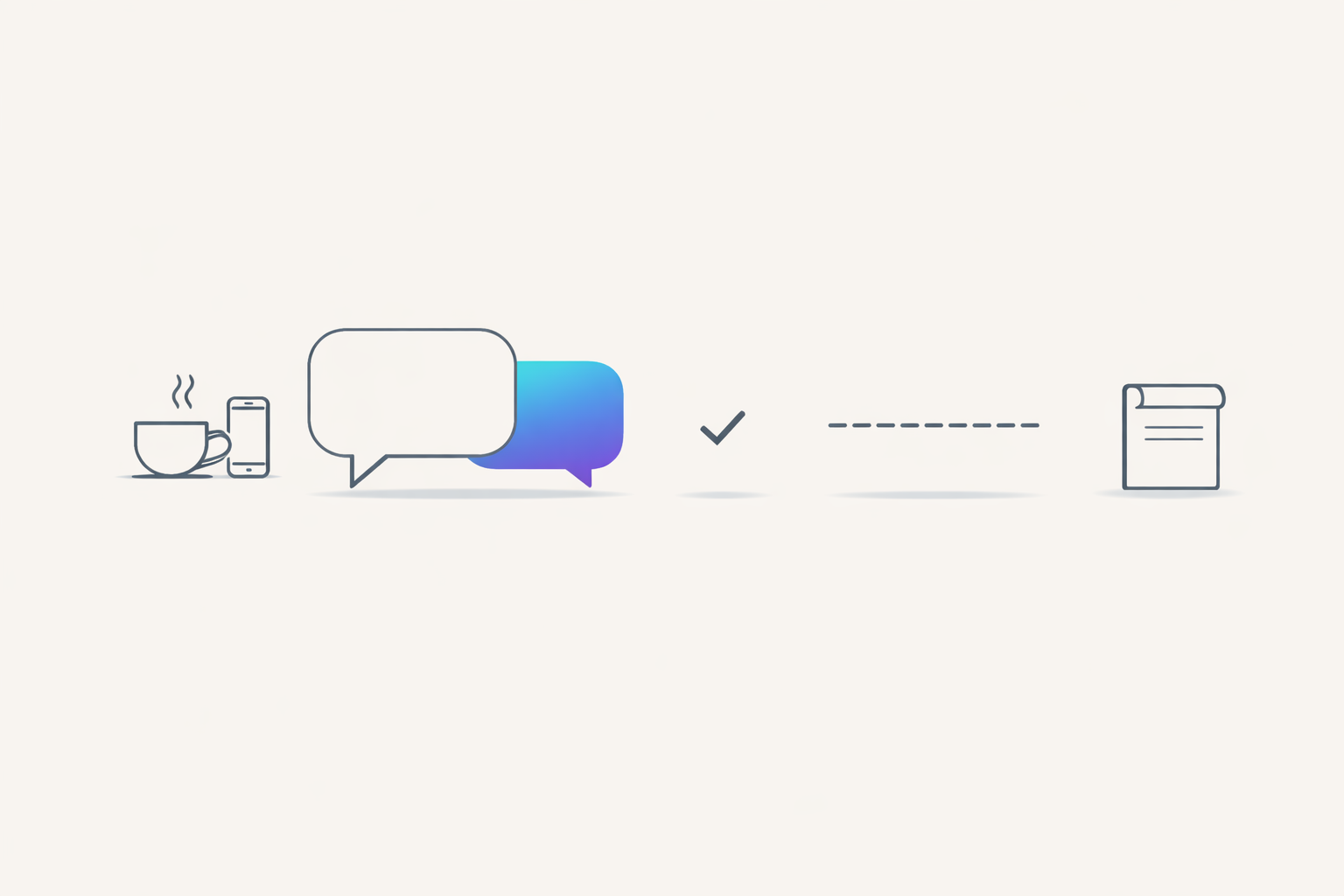
- Pick a topic from your own day, not from a textbook list. There are prompts from your own week if your mind goes blank.
- Speak for sixty to ninety seconds without stopping to fix yourself.
- Take the one correction. Read the label: wrong, or correct but not natural.
- Say the fluent sentence aloud twice. Out loud, not in your head.
- Use the same structure once more in a new sentence of your own invention.
- Ask for the one-line summary described in the next section, then stop.
An illustration of what a good turn looks like, written to show the shape rather than to report a real chat: you say “I am agree with the new plan but we need more time”. The reply names one thing, “I am agree” as wrong, gives you “I agree with the new plan”, explains in one line in your language that “agree” is already a verb in English, and asks you to say the sentence again. That error is documented for Spanish speakers, who carry “Estoy de acuerdo” across word by word; your first language will have its own favourites. Six sessions like this a week is a two-minute daily routine.
How do you make it remember your mistakes
This is the part you have to do yourself, and it takes about fifteen seconds.

- End every session by asking for one line in a fixed format: “Mistake: … / Fluent version: … / Date: …”.
- Paste that line into one note, under the lines already there. One note, forever, not one per day.
- Open the next session by pasting your open lines back in with a request: give me a chance to use each of these.
- Cross a line off after you have used it correctly on three separate days. Keep at most three open at a time.
The crossing-off habit is taught in full where you practise with an AI for free, so we will not rebuild it here. ChatGPT does have a memory feature. At the time of writing we could not confirm from OpenAI’s own pages what it stores, which plans include it, or whether it brings anything back unprompted, so we make no claim either way. The distinction worth holding is simpler: storing a fact about you is not the same as scheduling a mistake to return on a chosen later day. Two-Minute Speaking closes a line only after three correct uses in three separate sessions, and that is our design choice rather than a research finding. We take up the question of whether ChatGPT voice mode can replace a speaking app in a separate article.
When to let it talk without correcting you
Some sessions should have no corrections at all. If you have not spoken English aloud in months, or your throat closes on the first sentence, the first job is volume and nerve. A correction after every sentence can make that worse, and it is honest to say the research has not settled the timing question: the same 2023 review notes that “the timing of correction is still a point of contention among researchers”.
For those days, run a fluency round. Tell it: do not correct anything, ask me short questions, keep me talking for three minutes, and at the end name one pattern you noticed. You get speech volume plus one observation, with no interruption. If the freeze is the real problem, read why you freeze when you speak and what helps with English speaking anxiety before you worry about articles and tenses.
Our switching rule: once you can talk for the full two minutes without stopping, go back to one correction per turn. Fluency first, accuracy next, not both at once.
Five checks that the session was worth it
Run this list in ten seconds, the moment you close the app.
- Did I speak more than it did?
- Did I get exactly one named mistake, not zero and not six?
- Did I say the fluent version aloud?
- Did I save it as one line in my note?
- Is that line waiting for me on another day?
Two or more “no” answers means the setup is wrong, not your effort. Paste the block again, shorten the session, and test it with one sentence you know is wrong. This is a process check and nothing more. No study measures learning outcomes from ChatGPT speaking practice, so nobody, including us, can tell you how many sessions buy you what.
Questions people ask about practising with ChatGPT
Can ChatGPT correct my spoken English mistakes? Yes, when you instruct it to and when it heard you correctly. It corrects the transcript of your speech, not the sound you made, so read that transcript if one is shown. One correction you repeat out loud beats a list of six you scroll past.
Why does ChatGPT keep telling me my English is great? Because agreeable answers are a documented behaviour of assistants trained on human feedback, not a verdict on your English. OpenAI rolled back a whole model update in 2025 for exactly this. A single line in your setup, “do not praise my English”, plus the wrong-sentence check, fixes it in most chats.
Can ChatGPT check my pronunciation? Not in any way you should rely on. In a study comparing generative AI with human raters, the AI scored pronunciation more leniently and failed to tell weaker speakers apart. Use it for words you cannot say at all, and get a human or a purpose-built scorer for anything finer.
Is ChatGPT voice mode free for English practice? At the time of writing we could not confirm current free-plan voice limits on OpenAI’s own pages, so check the official help centre and treat figures on third-party blogs as guesses. If voice is capped on your plan, the same block works in typed chat.
How long should a ChatGPT speaking session be? Short enough that you will do it again tomorrow. Two minutes of your own speech, one correction and one saved line is a complete session. Long sessions feel productive and leave you with nothing to carry forward.
The setup above works, and it leaves you as the memory: you save the line, paste it back and remember which day it is due. If you would rather have that done for you, Two-Minute Speaking, the app this site publishes, keeps the list and brings each mistake back on its own schedule. Try a placement session and see.
Leave a Reply