
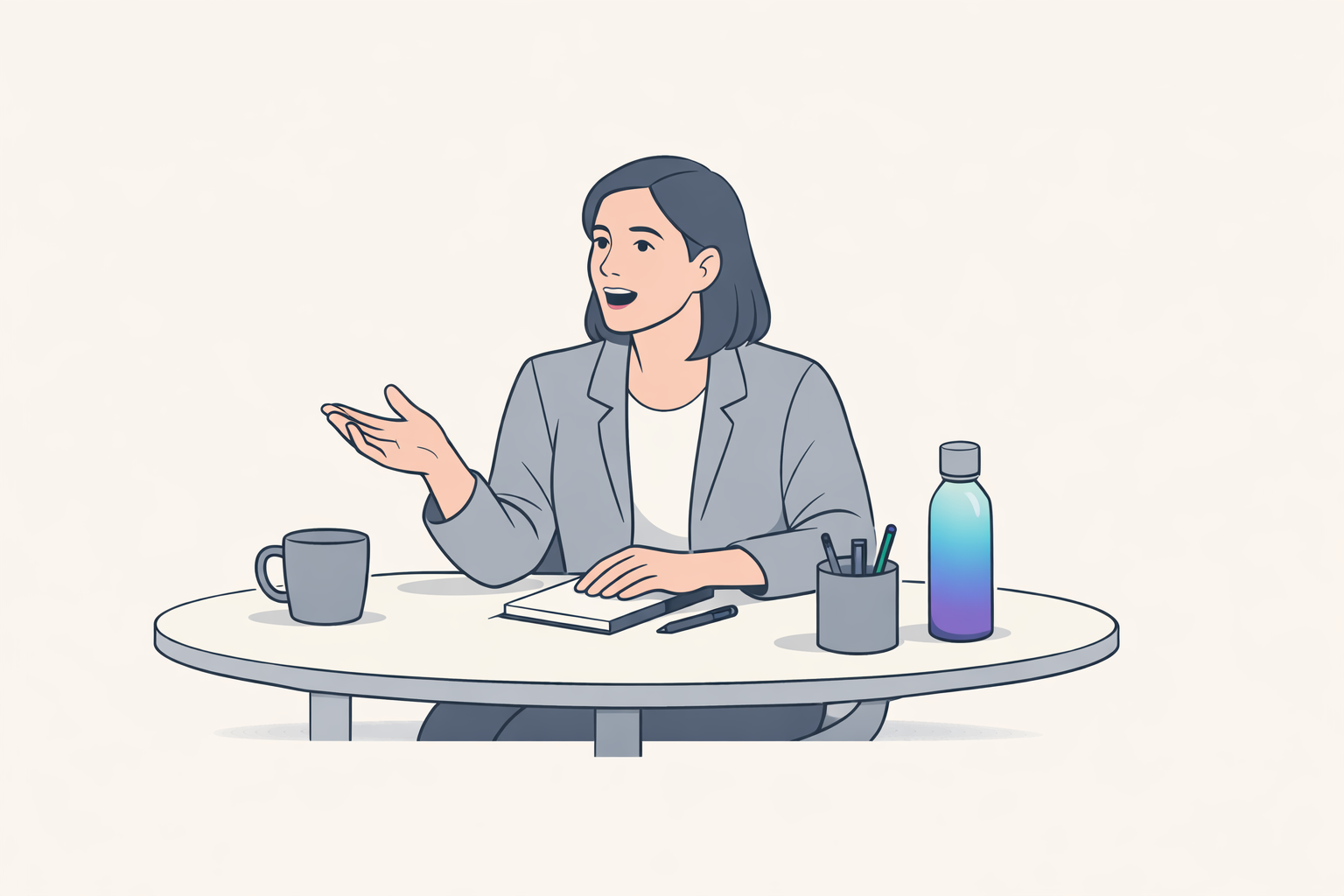
You freeze because speaking English in real time asks four things of you at once: decide what you mean, find the words, assemble the grammar, and move your mouth. You do it while someone watches and while you listen to yourself. Any part of that chain you have not automated needs conscious attention, and conscious attention is already spent. Knowing English and running English live are two different abilities. The freeze is mechanical, common and documented. It is not a sign that your English is bad.
Why do you freeze when you try to speak English?
The thing that stops you has a name in the research literature: foreign language anxiety. Horwitz, Horwitz and Cope described it in 1986, in The Modern Language Journal, as a distinct complex of self-perceptions, feelings and behaviours that comes out of the language learning situation itself (source). It is not shyness. It is a state one situation produces in people who talk fluently in their own language.
A 2025 study of English teachers in Egyptian higher education names what learners fear in that moment: making mistakes, being judged, and struggling to find the right words quickly in real-time communication (source). Two of those three are about speed, not knowledge.
This article gives you the mechanism, moves for a conversation tonight, and a two-minute daily practice that needs nobody else. You will not be told to relax or to be confident; those are outcomes, not methods.
Is it anxiety, or is your English just not ready?
There are two separate causes and most people blame the wrong one. Anxiety eats the attention that live speech needs. Foreign language anxiety limits attentional control and leaves learners more prone to distractors (source), and MacIntyre and Gardner reported in 1994 that it interferes at input, processing and output, not only at the end.
The other cause is that the English itself is not yet automatic. Automatization is the learning process by which controlled, effortful second language (L2) processing becomes automatic, fast, and effortless through practice (source). A structure you can explain but still assemble by hand is slow whether or not anyone is watching.
Here is how to tell which is yours. If the sentence arrives easily alone in the car and vanishes in the meeting, that is load. If it will not come alone either, that is automaticity. Most people have some of both.
Over 85% of the teachers surveyed in a 2025 Egyptian higher-education study named speaking the most anxiety-provoking of the four skills (source). Learner self-reports are more mixed: in a study of Chinese college students, listening scored higher (source). Reading and writing stay fine while speaking fails, because they give you time and a delete key.
What happens in the two seconds before you freeze?
Willem Levelt’s model (1989) divides speech production into three sequential stages: conceptualization, formulation and articulation (source). In plain words: you decide what you mean, you find the words and grammar, then you speak. You also monitor yourself. In the perceptual loop account, a speaker checks speech by hearing what has been said and by perceiving what is planned before it comes out (source).
Every stage you have not automated borrows conscious attention, and there is not much of it. Nelson Cowan concluded in 2001 that the focus of attention holds about four chunks in normal adults (source). Some of those few slots are already taken by the listener’s face and the fear of getting it wrong.
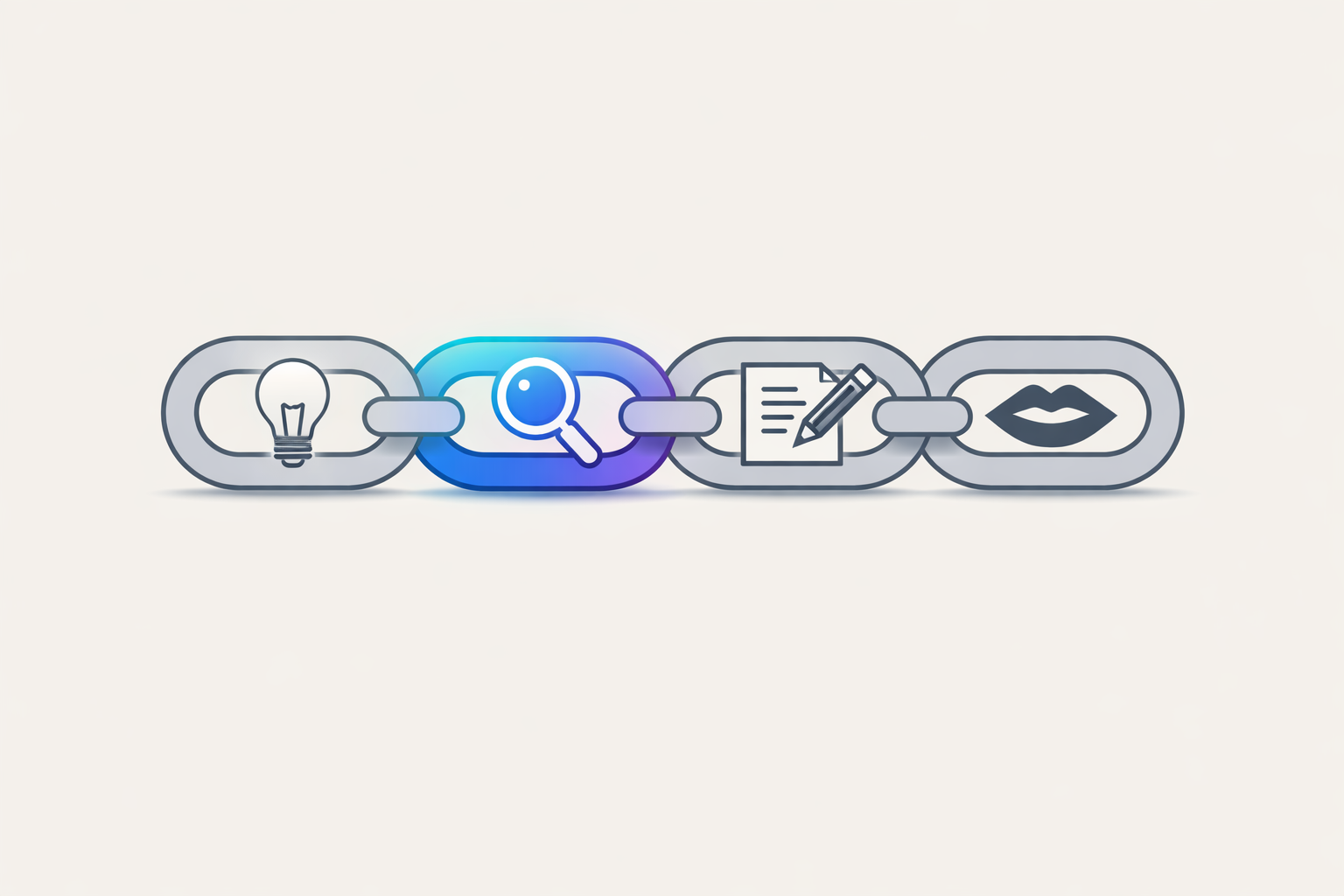
Then the loop closes. When a speaker detects an error during production, speech is halted and a restart is initiated (source). The restart re-runs the sequence, and the word you had lined up is gone. In one study of second language speaking tasks, surges in anxiety frequently coincided with breakdowns in fluency and with problems retrieving a word; pausing was tied to momentary jams in cognitive processing (source). That is the freeze: a traffic jam, not a character flaw.
Why does freezing get worse as your English gets better?
Because the monitor gets better too. A bigger vocabulary means more candidate words competing for the same slot, and choosing takes time that a live sentence does not have.
A better ear makes it worse a second way. One route of self-monitoring runs before you speak, on the planned sentence (source), so the more errors you can hear, the more get caught mid-formation. Detection halts production. A sharper ear buys you more halts.
Someone who knows less speaks more freely, because there is less to check against. This is why more grammar study does not fix freezing, and why years of courses can leave it exactly where it was. Grammar was never the bottleneck.
What do you do in the moment you freeze?
Five moves work in a real conversation tonight. Each one either lowers the load or refuses the halt-and-restart cycle.
- Say the simpler sentence instead of the right one. Fewer moving parts, fewer attention slots used.
- Finish the sentence wrong rather than abandoning it. Abandoning it triggers the restart, and the restart costs more than the mistake.
- Use a holding phrase. “Let me put that another way” buys planning time without silence, and silence is what tightens the room.
- Drop the clause you were building and start a short new sentence. A long sentence in progress is a plan you must hold while you talk.
- Keep your eyes on the listener, not the ceiling. This one is experience, not research: looking away signals trouble, and their reaction adds to the load.
These are rescues, not a cure. They get you through the meeting; they do not build the automaticity that would have stopped the freeze.
What does not work, and why?
“Just be confident” asks for the outcome as though it were the method. Confidence is what you have after the sentence comes out.
Memorised long answers collapse as soon as the question is phrased differently: a script is one fixed path, and a conversation is not. Short prepared phrases survive; paragraphs do not. “Think in English” has the same problem in reverse, describing automaticity rather than producing it.
More films and more podcasts train comprehension, which is already your strong side. The automatization literature is fair but clear: mere exposure is insufficient, and deliberate, systematic, goal-directed practice is integral (source). Input is not useless. It just does not do this job.
Why two minutes is long enough to change anything
What is missing is automaticity, and automaticity comes from repeated retrieval spread across days. The review by Cepeda, Pashler, Vul, Wixted and Rohrer (2006) in Psychological Bulletin found 839 assessments of distributed practice in 317 experiments located in 184 articles (source). Spread beats massed. A session short enough to repeat tomorrow beats a long one you avoid.
The second constraint is attention. You hold about four chunks, and monitoring takes some of them, so a lesson that corrects eight things changes none of them. Two minutes is our own design decision, not a research finding: it is the length that survives a bad day.
Ali Saberian built Two-Minute Speaking on those two rules. One point per session, explained in your own language. Every mistake becomes a named item in an error ledger across six categories, and an item closes only after correct use in separate later sessions, three by default. At most three stay open at once. The rest is on the page about how a two-minute session works.
What does a two-minute practice look like this week?
You can run this alone, with a voice recorder and no app at all. Two minutes a day, six days.
- Day one. Answer one real question from your own week out loud for two minutes. Record it, listen once.
- Day two. Pick the single thing you heard yourself do twice, and say five sentences that use it correctly.
- Day three. Same target, new sentences, taken from tomorrow’s actual conversations.
- Day four. No recording. Use the target in one real sentence with a real person.
- Day five. Record two minutes on a different question and check whether the target survived.
- Day six. Answer day one’s question again.
Choose the target from evidence, not a feeling: the thing you heard twice on the recording, or the thing the person you speak English with most says they notice. A fixed list helps you name the mistake you keep making instead of guessing.
The goal for the week is one closed item, not a feeling of improvement: a named thing that used to stop you and now does not.
How do you sound more confident in English at work?
Meetings and interviews are the easiest case: the load is predictable, so you can prepare against it. Rehearse only the first fifteen seconds, since the freeze usually lands at the start, before any momentum exists.
Answer in one sentence, then explain. Building up to your point keeps a long plan in memory while you talk, and that plan is what drops when the monitor interrupts. Prepare the three phrases you will actually need, not a script.
Slower, simpler English delivered without stopping reads as more confident than complex English delivered in fragments. Your listener is waiting to find out what you think, not grading your grammar.
Where to start tonight
The freeze does not close by reading about it. Pick the one thing you heard yourself do, and say it correctly out loud tonight, for two minutes, with something that will tell you whether you got it right. Start a two-minute session with a short placement session, and it will name your first one.
Leave a Reply