
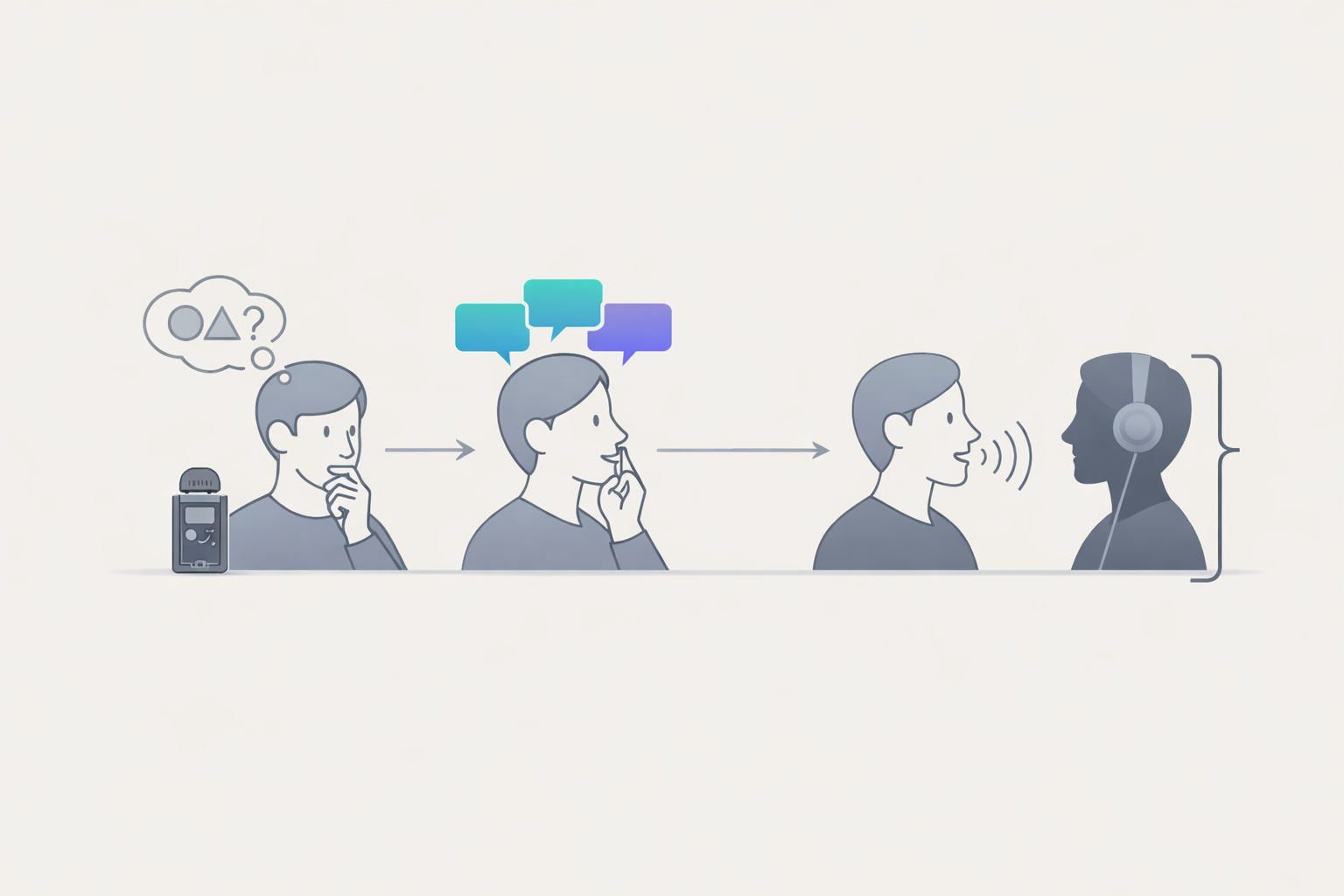
Shadowing technique English learners try first trains your mouth, but does it make you speak, or only make you sound better copying someone else? Mostly the second. Shadowing means speaking along with a recording, a beat behind the speaker, matching their sounds, stress and rhythm. It works on a narrow band: pronunciation, prosody, and the speed your mouth can move. It does not train retrieval, the act of finding your own words under pressure. So it will not, by itself, stop you going blank when a colleague turns and asks you a question.
What does one shadowing session actually look like?
You put on headphones, start a short clip, and speak about one beat behind the model. You never pause the audio. Your mouth chases the speaker and copies everything: the vowels, the word stress, the places where a syllable gets swallowed. One teaching source describes the drill as repeating an audio just after you hear it, as Leonardo English puts it.
That “just after” separates shadowing from listen-then-repeat. Another widely read guide defines it as repeating aloud what you hear, word for word, with as little delay as possible. In listen-then-repeat you stop the audio and hold the sentence in memory first. In shadowing there is no gap. Two variants are common: full shadowing, almost on top of the speaker, and slightly delayed shadowing, half a clause behind.
What does shadowing actually train?
Shadowing trains the parts of speech that live in your mouth and ears. A summary of the second-language research reports that shadowing boosts phonological encoding, leading to better short-term retention of language chunks, a finding it attributes to Shinichi Kadota. The same summary reports that Jennifer Foote and Kim McDonough’s mobile shadowing study found significant gains in pronunciation accuracy and prosodic fluency.
The listening side is real too. That summary describes a Yo Hamada condition where fine-grained attention to the input improved lower-intermediate learners’ decoding of connected speech. Persian speakers gain most here. Persian has no /w/, so “water” comes out as “vater” until your mouth builds the shape; these are the sounds Persian speakers have to build from scratch.
Warning
Notice what those studies measured: pronunciation ratings, prosody, listening comprehension, and the shadowing task itself. None we could read measured spontaneous conversation. The primary papers sit behind paywalls, so these findings come from secondary summaries.
Why shadowing does not stop you freezing
Speech production runs in stages. In Levelt’s model, widely used in psycholinguistics, you decide what you mean, then build the words and the sentence plan, then move your mouth. Shadowing hands you the first two stages ready-made. The recording chose the idea and assembled the words. That is why it feels smooth: nothing is being retrieved.
Retrieval is the step that fails. Hesitation markers in second-language speech, says one study of speaking anxiety, appear in environments in which speakers have difficulties in retrieving lexical information during speech production. That study tracked four speakers moment by moment and found significant positive correlations between anxiety and pause length in three of the four performances. It is a small time-series design, not a large sample, but it names the thing precisely. It is why your sentence stops halfway.
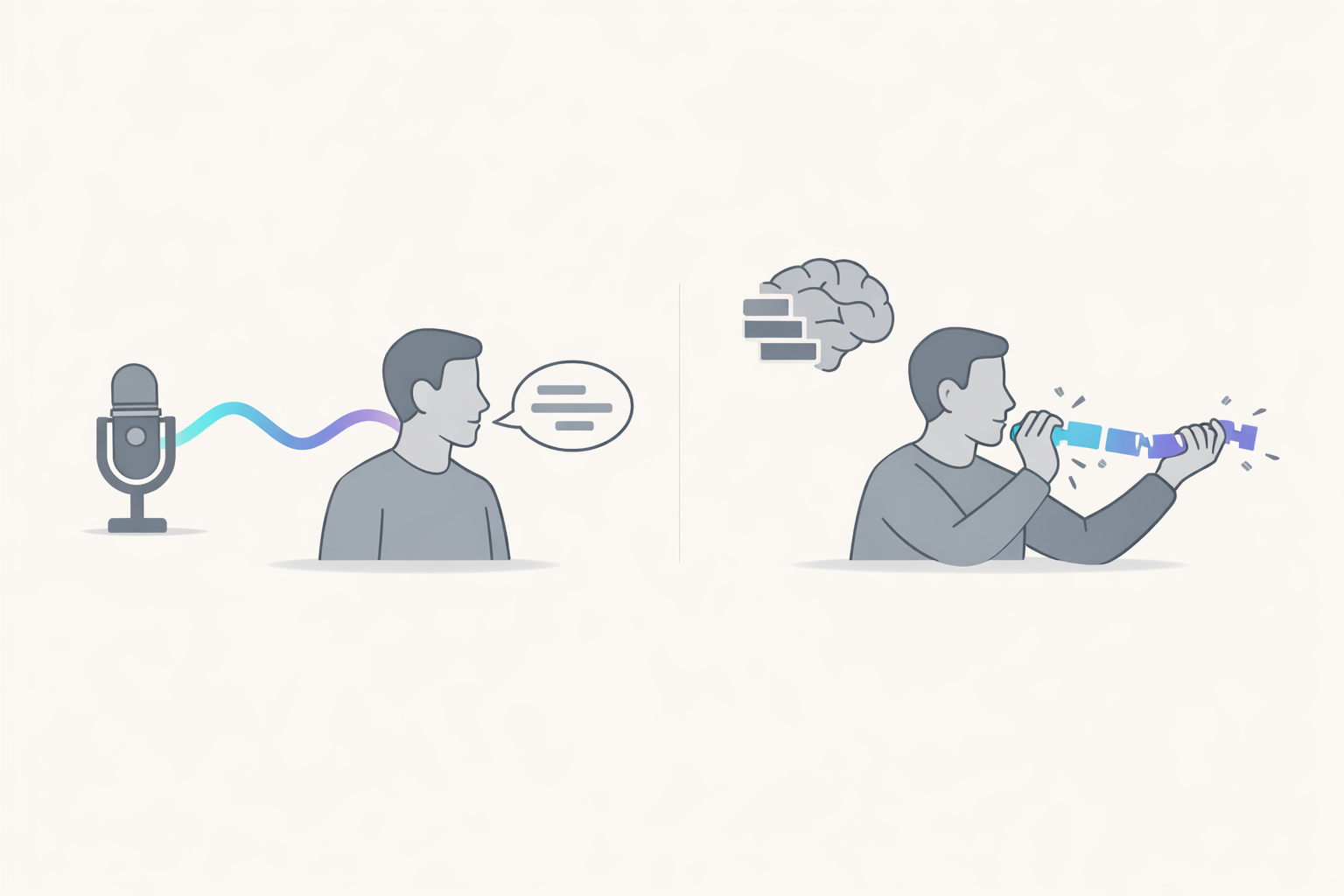
Producing beats copying, and that has been tested. A secondary summary of a vocabulary experiment by Sean Kang, Tamar Gollan and Harold Pashler describes two conditions. In retrieval, the learner was prompted to attempt to pronounce the word, then the audio file was played. In imitation, the word and the audio arrived together. Retrieval outperformed imitation on both immediate and delayed tests. The twist: during practice itself, pronunciation quality was significantly lower under retrieval. The harder method lost in the room and won on the test.
Which problem does each one fix
The comparison below is our synthesis of the studies above, not a table lifted from any single paper. Name your own problem before you spend your next five minutes.
| Shadowing (imitation) | Producing (retrieval) | |
|---|---|---|
| Trains | Sounds, word stress, rhythm, chunk timing | Word-finding, sentence assembly under time pressure |
| Feels | Easy and fluent while you do it | Slow, effortful, sometimes embarrassing |
| Evidence | Pronunciation and prosody gains, listening decoding | Beat imitation on immediate and delayed production |
| Fixes | People asking you to repeat | Going blank mid-sentence |
The two modes share some ground. Shadowing builds confidence in the mouth and a feel for where chunks break, and that carries over. It cannot supply the missing step, because the recording performs that step for you.
A five-minute shadowing protocol you can run tonight
You need a phone, headphones, and one clip of 20 to 30 seconds with a transcript. Session lengths in the research summaries cluster in the 10 to 20 minute range, several times a week. Five minutes daily is our design choice, not any study’s protocol; it is short enough that you will repeat it tomorrow.
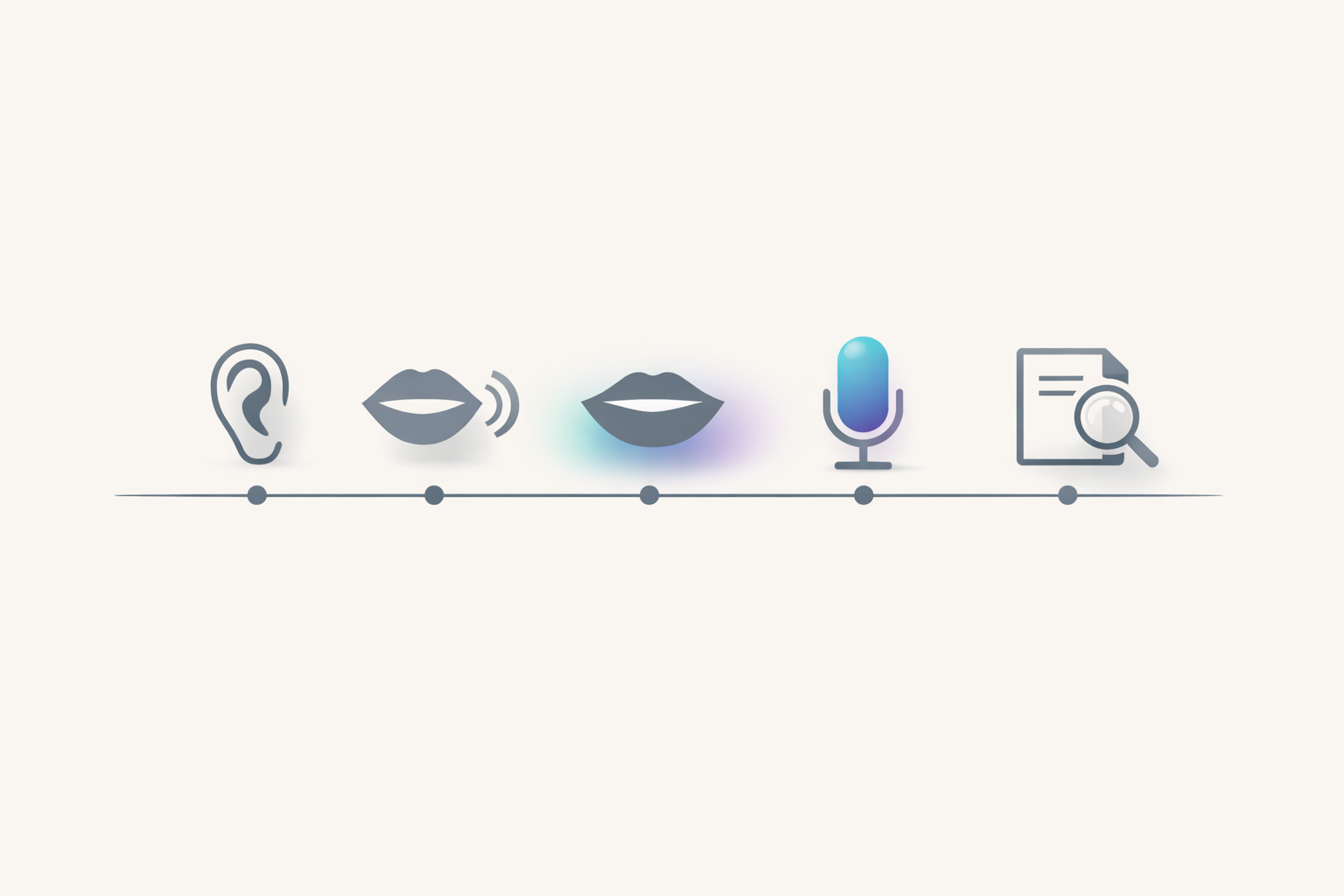
- Minute one, listen only, and mark the two places where the speaker’s rhythm surprises you.
- Minute two, shadow with the transcript visible. Failure mode: reading aloud instead of chasing the audio.
- Minute three, shadow with the transcript hidden. Failure mode: stopping when you fall behind; let the gap go and rejoin.
- Minute four, record yourself shadowing the clip once.
- Minute five, compare your recording with the model and name one difference in words, such as “my stress lands on the second syllable, his lands on the first.”
Tip
Say the expected difference out loud before you listen back. Predicting the error turns the comparison into retrieval instead of another round of copying, which is the switch the Kang experiment rewarded.
What should you shadow?
Shadow sentences you would plausibly have to say this week. A standup update, a clarifying question in a meeting, a call about your rent. A TED talk trains you to sound like someone giving a TED talk, a situation you will never be in. Scripted monologue is cleaner and slower than real conversation, so it drills a register you will not meet.
Pick clips at a speed you can chase without panicking, then move up. On accent we found no evidence either way; nothing we read showed that American or British English changes outcomes. Choose the variety of the people you talk to. If you have nobody yet, this pairs with other ways to practise speaking English alone.
Three signs it is time to stop shadowing and start producing
Shadowing has an exit point, and almost nobody names it. Check these three tonight, right after your five minutes.
- You can say the clip at the model’s speed without looking at the text.
- Your recording and the model differ only in voice, not in rhythm or stress.
- The sentences you shadow well still do not arrive when nobody hands them to you.
Two out of three means the next five minutes belong to production. This mirrors how Two-Minute Speaking closes an item: a named error is finished not after one correct repetition, but after several correct uses across separate, spaced sessions, three by default. Correct once while copying is not evidence.
Why experienced learners still shadow every day
Because interpreters do. Shadowing began in interpreter training, and one trainer argues it involves some 80% of the neuro-linguistic operations involved in simultaneous interpretation, the only factor missing being that of language transfer. For someone who must hold and reproduce speech in real time, the drill sits close to the job.
The same trainer is careful in a way the internet is not. He calls shadowing controversial and often misunderstood or discounted, and insists it works only when it is graduated, supervised and combined with other training. The field is still moving. We found a systematic review of research on the use of shadowing for second language pronunciation teaching exists behind a paywall we could not read past, a sign the question is still open. Keep shadowing if pronunciation is your named problem.
How shadowing fits a two-minute daily routine
Short and frequent survives the evidence. A study of distributed practice in second-language fluency training compared one-day and seven-day spacing and found that the posttests conducted 7 and 28 days after the training showed similar fluency gains for the two groups. Spacing need not be long to work, so a small daily session is defensible.
A workable week: shadow on three days, produce on four. Two minutes of production is enough when it carries one point, which is how a two-minute session works in Two-Minute Speaking. Its error ledger sorts mistakes into six categories; pronunciation and nativeness are two, and the other four never surface while you shadow. The two-minute length is a design decision, not a research finding. The full routine is daily English speaking practice in two minutes.
Questions people ask about shadowing
How long should I shadow each day? Secondary summaries describe sessions in the 10 to 20 minute range, several times a week. Five minutes daily is a smaller dose you are more likely to keep. Consistency across days matters more than the length of one session.
Does shadowing improve speaking or only listening? It improves the speaking you can already plan: sounds, stress, rhythm, and the decoding of fast speech. In the sources we read, the measured outcomes were pronunciation, prosody, listening comprehension and the shadowing task itself, not free conversation.
Can I shadow if I do not understand every word? Yes, and it still trains articulation and rhythm. But a clip you do not understand cannot become a sentence you use, so keep those sessions short. Understanding is what lets you retrieve the phrase later without the audio.
Is shadowing better than repeating after a recording? They are different drills. Shadowing runs at near-zero delay; listen-then-repeat makes you hold the sentence first, which adds a small retrieval step. Given the Kang findings, the version that asks you to produce first is the one that transfers.
Should I shadow American or British English? No source we read showed an outcome difference between varieties. Choose the accent of the people you speak with at work or in your city, and stay with it long enough for the rhythm to settle.
Shadowing hands you the sentence; the app makes you find it. Run a short placement session at Two-Minute Speaking and it will name the first thing your own speech gets wrong. You can start a two-minute session now.
Leave a Reply