

Seven patterns cover almost all of the English pronunciation Persian speakers get asked to repeat. /w/ turns into /v/, the two th sounds swapped for s, z, t or d, an extra vowel in front of street and school, ship and sheep collapsing into one vowel. Stress on the wrong syllable, the missing schwa, and trimmed clusters at the ends of words. They do not cost the same. Two of them hide whole words from your listener. The rest mostly just sound Persian, which is a smaller problem than you think.
Which pronunciation mistakes actually stop people understanding you?
Phonologists measure how much work a contrast does, and they call it functional load. The omission or mishearing of features with a high functional load leads to more confusion than features with a low functional load. A contrast that separates hundreds of everyday words earns your two minutes. One that separates almost nothing does not, however foreign it sounds.
The ranking below is our editorial judgement, built on functional load and on the Lingua Franca Core, a selection of pronunciation features recommended as a basis in teaching of English as a lingua franca. It was proposed by the linguist Jennifer Jenkins. No published study ranks these seven patterns for Persian speakers.
| Pattern | Word that breaks | Cost to the listener |
|---|---|---|
| Wrong syllable stressed | REcord said as reCORD | High |
| Vowel pairs collapsing | ship, sheep | High |
| /w/ said as /v/ | west, vest | Medium |
| Extra vowel before clusters | street, school | Medium |
| Trimmed final clusters | asked, texts | Medium |
| No schwa, every syllable full | comfortable | Low to medium |
| th replaced by s, z, t or d | think, this | Low |
Notice what sits at the bottom. The th sounds, the thing you have been told to fix since school, come last. Stress and vowels, which nobody ever gave you a drill for, come first.
Why does west come out as vest?
Iranian Persian has one stable sound where English keeps two apart. The phoneme in question is [a stable [v] in the onset](https://en.wikipedia.org/wiki/Persian_phonology) in Iranian Persian, while the same historical sound is read as /w/ in Dari and Classical Persian. Reaching for English /w/, your mouth has no category of its own to reach into, so it takes the nearest one it owns.
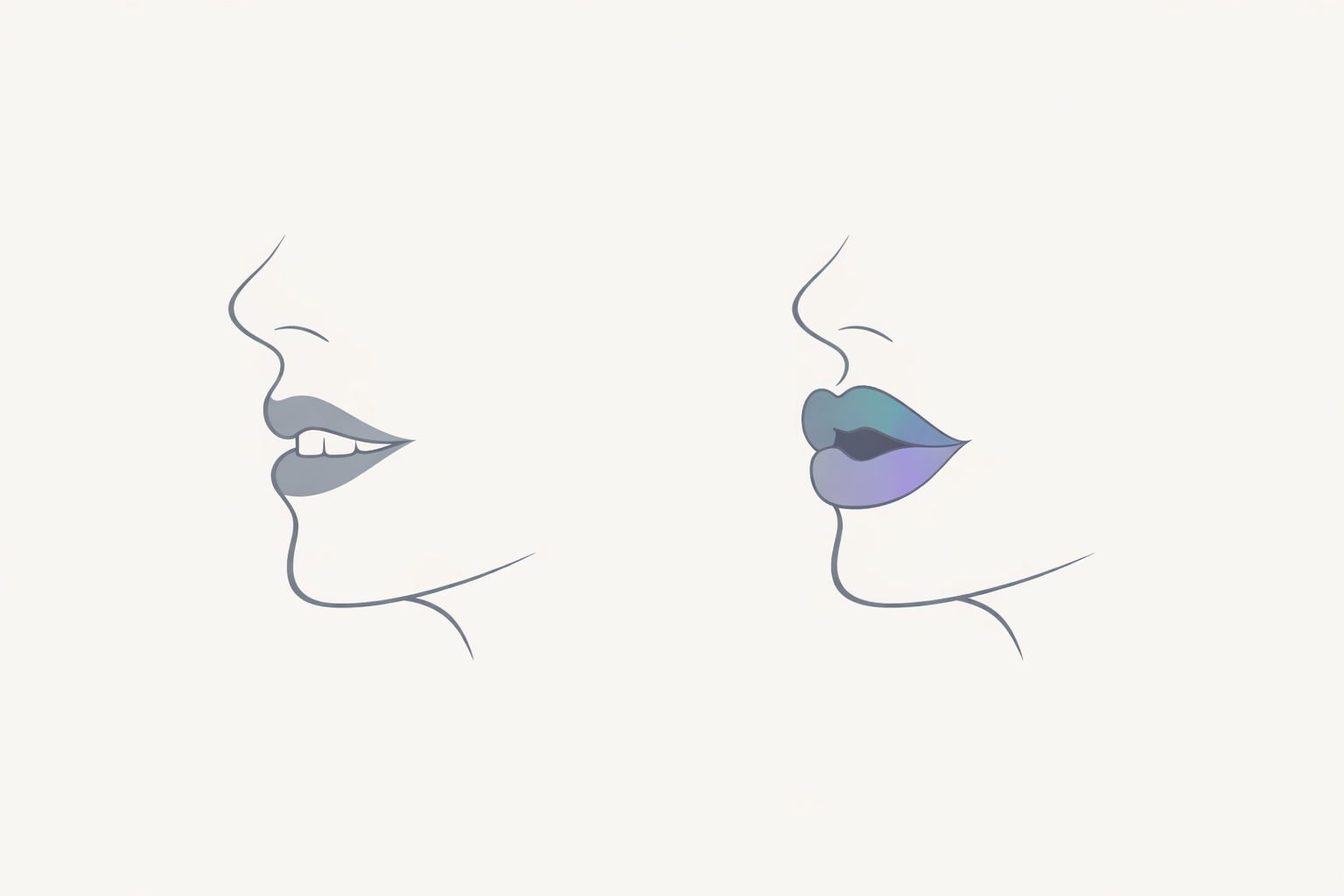
The fix is a place, not an effort. /v/ is a labiodental fricative, articulated with the lower lip and the upper teeth. English /w/ has no teeth in it at all: the lips round and push forward, like the start of a whistle. Rest a finger against your upper teeth and say west. If your lip arrives at the finger, you said vest.
Drill it in pairs where the swap changes the meaning: west and vest, wine and vine, worse and verse. The pair forces the decision.
What happens to think and this in a Persian mouth?
Neither th sound exists in Persian, so both get replaced, usually with s, z, t or d. Teachers of Persian speakers report that pattern consistently, but we found no study that measures it, so treat it as typical, not universal.
Now the uncomfortable part. Under the Lingua Franca Core, the th sounds may be substituted by other consonants without intelligibility suffering. Real minimal pairs exist and are worth knowing: think and sink, thank and sank, they and day. Context usually rescues them. Nobody hears “I sink so” and pictures a boat.
One caveat, in fairness. That feature list is contested, and the legitimacy of inclusion or exclusion of certain features has been challenged, with th among the disputed items. So th is a low priority, not a non-priority. Fix it after the two at the top of the table.
Where does the extra vowel in estreet and eschool come from?
The extra vowel comes from a rule you have never had to think about. In Persian, the onset is composed only of one consonant; consonant clusters are only found in loanwords, sometimes an epenthetic vowel is inserted between consonants. English opens words with two and three consonants together. Your mouth meets str-, finds a shape Persian does not build, and repairs it the way it has always repaired borrowed words. Nothing careless is happening. A rule is doing its job in the wrong language.
Because it is a rule, speaking more slowly makes it worse, not better: it gives the repair more room. Rebuild the onset instead.
- Hold the vowel on its own, long: eeee for street.
- Add the consonant that touches it, treeee, then the whole cluster, streeee.
- Say the word at half speed with your lips already in position before any sound leaves.
- Say it inside a phrase you use, like on my street, never alone.
Word endings need the opposite attention. Clusters in asked, texts and months get trimmed by many Persian speakers. No published measurement of this in Persian-accented English turned up in our research, so treat it as teacher-reported and check your own recording before spending time on it.
Why do ship and sheep sound the same when you say them?
Because you have fewer boxes than English has vowels. Standard Iranian Persian has six: three short vowels, /æ/, /e/ and /o/, and three long vowels, /ɒː/, /iː/ and /uː/. English has substantially more, and it separates ship from sheep, full from fool, bed from bad by vowel quality as much as by length. Two English vowels land in one Persian box, and the box returns one sound.
Length alone will not save you, and this is where self-teaching usually goes wrong. Modern Iranian Persian does not feature distinctive vowel length; its long and short vowels differ in quality. So do the English pairs. Holding the vowel in sheep for longer does not make it sheep. The tongue has to sit higher and further forward, and the muscles have to tense. Listen for your jaw, not the clock.
Which syllable takes the stress and why does the wrong one hide the word
Persian stress is largely predictable: accent is heard on the last stem-syllable of most words. A lifetime of that gives you no practice at storing a stress position separately for every single word. English demands exactly that. Stress is part of the word, like a letter, and the spelling will not tell you where it goes.
The clearest case is the noun-verb pattern: for many two-syllable words that can be both nouns and verbs, nouns stress the first syllable and verbs stress the second. REcord and reCORD. PREsent and preSENT. PERmit and perMIT. The vowels and consonants are identical. Only the beat moves, and the beat tells your listener which word arrived.
So a clean word with the wrong stress fails where a Persian-flavoured th sails through. That source notes using the wrong stress can cause confusion or make you sound non-native; it is teaching material, not a controlled study, and researchers disagree about how essential lexical stress really is. We still rank it first, because it fails silently. Your listener does not mishear a sound. They never find the word.
Tip
Learn every new English word as a rhythm, not a spelling. Say it three times with the beat exaggerated before you write it down. Dictionaries mark the stress; use that mark the way a French learner uses a gender.
Why does every syllable in your English come out full?
English does not give its syllables equal weight. One weak, colourless vowel fills most unstressed positions, and the reduced vowel sound called schwa is the most common vowel sound in spoken English. Comfortable is not com-fort-ab-le. It is KUMF-tuh-bul, with two syllables swallowed. Full value on every syllable leaves your English clear but heavy, and long sentences cost you more breath than they cost a native speaker.
The same reduction hits the small words. To, of, for, and, can almost never appear in their strong forms inside a running sentence. In “I can send it to you”, can shrinks to something close to kun. Keep it strong and you drift toward can’t, the opposite of what you meant. Give the content words the weight and let the grammar words shrink.
Rhythm is learned by copying, not by explanation. Hearing a sentence and saying it back at the same speed does more than any description of it, which is why shadowing is the natural companion to this section and the one above it.
Do you actually need to lose your Persian accent?
No, and it is worth settling the target before you spend a year aiming at the wrong one. Pronunciation teaching has argued for decades between two goals: sounding native, and being understood easily by any listener. The second is achievable and useful. The first is promised by no evidence we could verify, and an adult accent rarely disappears. Being understood at the first attempt is the outcome that changes your day.
People still work on their accent for real reasons, and dismissing them would be dishonest. Some are scored on it at work. Some are tired of “where are you from” arriving mid-sentence. Some want one less thing to think about in an interview. Nothing here says leave your accent alone. It says know which part of it costs comprehension and which part is simply where you are from.
Warning
Be sceptical of any page, coach or app that puts a timeline on losing an accent. Several pages competing for this search promise results in a set number of weeks or months with no source attached. No research we could verify supports a schedule for adult accent change, and we make no such promise either.
How do you find your two sounds and fix them two minutes at a time?
Start with evidence about your own mouth. Record yourself reading one short paragraph that plants an example of each pattern: a w-word, a th-word, a cluster word like street, a ship and sheep pair, a noun-verb pair like record. Add a sentence with weak forms, and a word ending in a cluster like asked. Sixty seconds is enough. Play it back once and tick every line where you had to concentrate to hear the difference between what you said and what you meant. Two ticks or fewer become your list for the next two weeks; everything else waits.
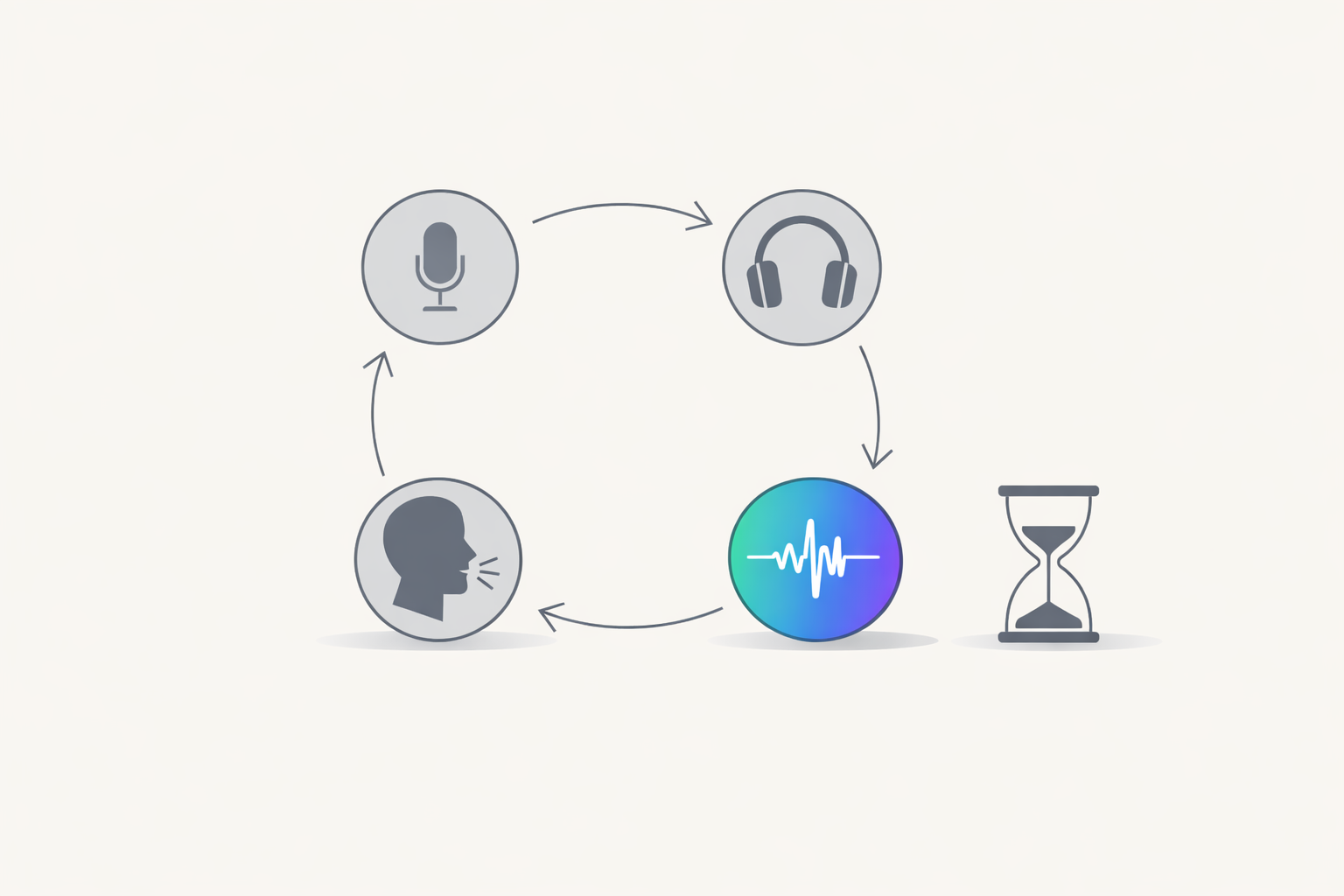
Then practise in a shape the research supports. High-variability phonetic training, in which listeners are exposed to a target sound as produced by numerous talkers, is documented for adults working on non-native contrasts. In one study of adults training on English rhotics, the varied condition improved short-term performance, yet the researchers report that long-term learning was limited in nature for both conditions. Repetition across days does the durable work.
Session length is the wrong lever. Spaced, or distributed, practice refers to learning that takes place over time with rest periods between practice sessions. Researchers have found drastic declines in the performance of students who used massed practice as compared to those who spaced their practice. Six short sessions across six days beat one long Sunday. That is the argument behind two minutes of speaking practice a day.
Two-Minute Speaking is built on that constraint: sessions under two minutes, one named point per attempt instead of a report card, every correction stored in an error ledger under a name you can search for. It never keeps more than three concepts open at once. Pronunciation scoring is planned and not available yet, so today the app names grammar, vocabulary and discourse errors while your recording names the sounds. If nobody can correct you at all, the wider case is in our guide to how to practise speaking alone.
Sound is half of what gets noticed in Persian-accented English. The other half, articles, prepositions, tense and word order, is in the grammar and vocabulary mistakes Persian speakers make.
Questions Persian speakers ask about English pronunciation
Which English sounds are hardest for Persian speakers? The ones Persian, also called Farsi in many searches, does not own or does not use the same way: the two th consonants, the /w/ and /v/ split, consonant clusters at both ends of a word. English vowels also crowd into a six-vowel system. Prosody belongs on the list too and rarely makes it: unpredictable word stress and the reduced schwa.
How do I stop saying v instead of w? Take your teeth out of it. /v/ needs the lower lip against the upper teeth; English /w/ needs rounded lips pushed forward with no contact at all. Hold a finger against your upper teeth and say west, wine, worse. If the lip touches the finger, reset and round your lips before the sound starts.
Why do I add a vowel before words like street and school? Persian allows only one consonant at the start of a syllable, and it already inserts a vowel into the clusters of borrowed words. English clusters get the same automatic repair. The fix is not more care; it is rebuilding the onset with your lips in position before any sound leaves.
Can an adult still change their English pronunciation? Yes, within limits worth knowing. Training adults on non-native sound contrasts is a documented research approach and produces short-term gains, while researchers caution that durable change from one training design is limited. That argues for small repeated sessions, and for aiming at being understood rather than at sounding native.
How can I practise English pronunciation without a native speaker? Record yourself, compare minimal pairs against a dictionary’s audio, and spread short sessions across days instead of massing them. Your own recording is the honest listener you are missing. Most people hear their own error on the second playback, even when they could not feel it while speaking.
Pick the one sound your recording flagged and say it out loud today inside a word you actually use, not in isolation. A two-minute session at Two-Minute Speaking gives you one named point per attempt, which is exactly how many a mouth can change at a time.
Leave a Reply