
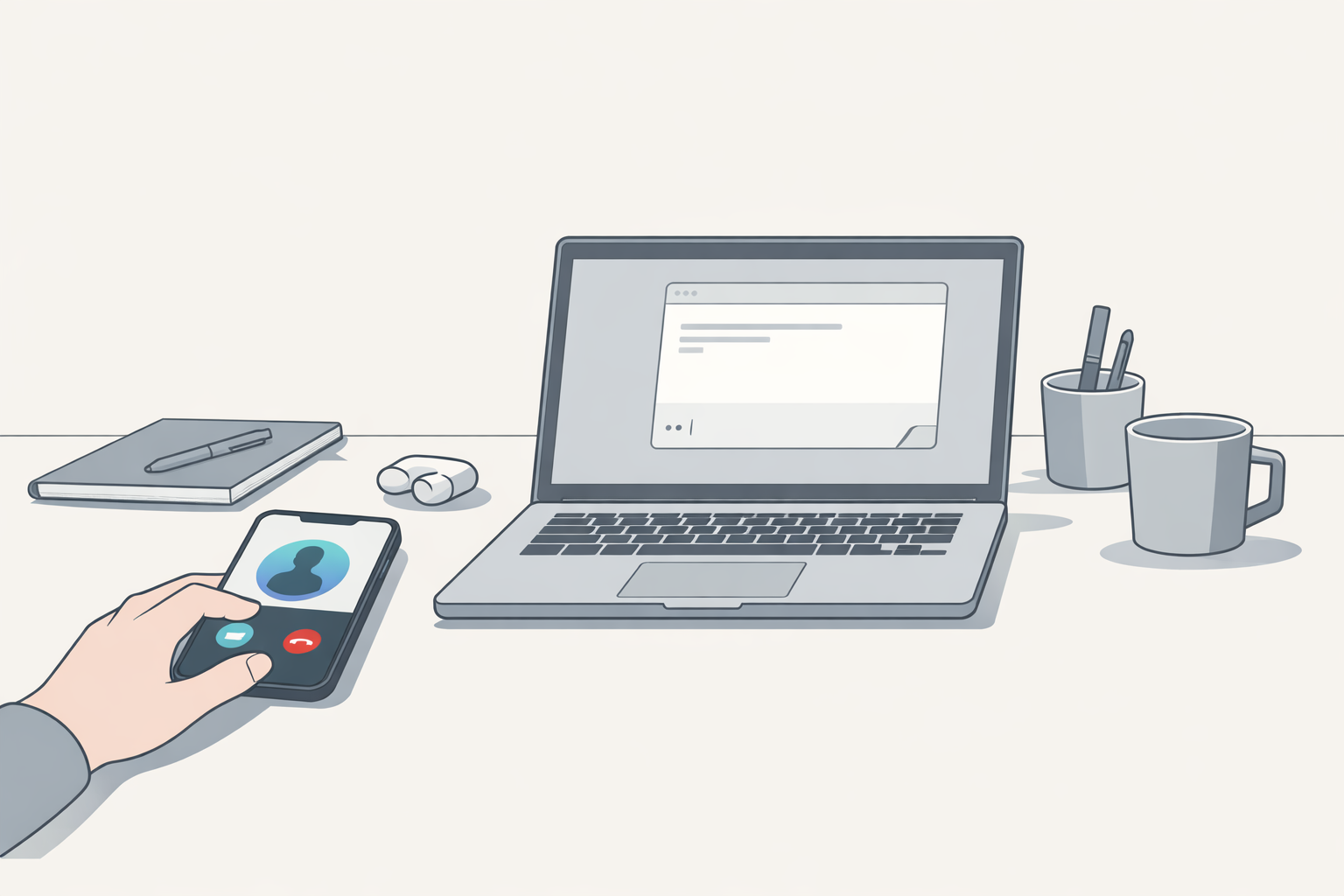
English speaking anxiety usually shows up as a small decision: someone asks for a quick call, and you send a long message instead. It is not a gap in your English. It is a documented, situation-specific reaction with a mechanism. The worry runs alongside the sentence and takes the attention the sentence needed, so the words are there and out of reach. It gets worse because avoiding the conversation brings instant relief, and relief teaches you the situation was dangerous. What lowers it is repeated speaking in situations ordered by stakes, starting lower than feels respectable.
Why does your mind go blank when you speak English?
Because the blank comes from the worry, not from missing vocabulary. Applied linguists named this in 1986. Elaine K. Horwitz, Michael B. Horwitz and Joann Cope described foreign language anxiety as a distinct complex of self-perceptions, beliefs, feelings, and behaviors related to classroom language learning arising from the language learning process itself. A named pattern, not a personal defect.
The mechanism is competition for one resource. Anxious thinking runs on the machinery your sentence needs: it consumes cognitive resources within working memory, constraining the capacity available for routine tasks, in a Frontiers in Psychology account of MacIntyre and Gardner’s account. Your vocabulary did not leave. The attention that reaches it went to watching the room.
Speaking takes the worst of it. In a survey of 49 English-as-a-foreign-language teachers in Egyptian higher education, over 85% viewed speaking as the most anxiety-provoking of the four skills. That is teacher perception in one country, not a global figure. It matches what you know: reading and writing are fine, and the mouth is where it collapses.
Is it English, or is it you in every language?
Both can be true, and your next move depends on which one dominates. Foreign language anxiety is situation-specific rather than a trait anxiety, meaning individuals without general anxiety may experience it specifically in language classrooms. A confident, talkative adult can have it in full.
Horwitz and colleagues also built an instrument for it: the Foreign Language Classroom Anxiety Scale, a multi-item questionnaire used widely in the field. They discussed communication apprehension, test anxiety and fear of negative evaluation, though these are discussed as descriptive lenses rather than a formal three-factor score. Three lenses, not three scores.
Run this self-check in a minute. It sorts your situation; it does not diagnose you.
- In your first language you talk easily with strangers, and in English you go quiet with people you know.
- Your written English at work draws no complaints.
- The dread attaches to specific situations with listeners, not to your whole day.
- It drops within minutes of the call ending.
Mostly yes means this is the language situation, and this page is written for you. Mostly no means something broader is running, and that belongs with a different kind of professional.
Warning
This describes a learning-situation pattern from applied linguistics. It is not medical advice and it diagnoses nothing. If the anxiety also appears outside language situations, or touches your sleep, work or health, ask a qualified professional.
How avoiding English conversations keeps the anxiety in place
Avoidance works, and that is the problem. Every dodge stops the discomfort within seconds, the fastest reward your nervous system can get. The situation never gets a chance to prove it was survivable.
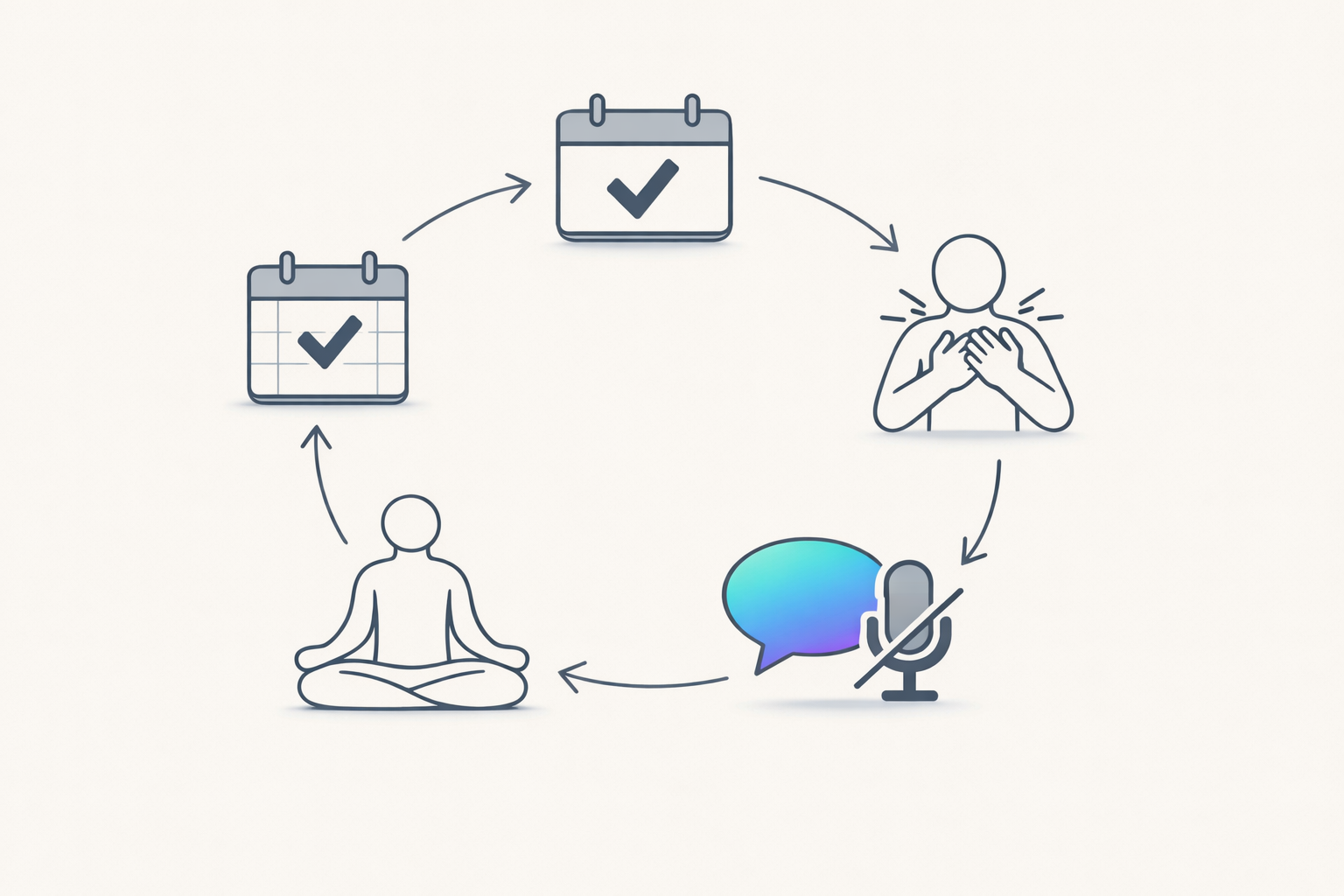
It looks reasonable from outside. You reply in chat because writing is clearer. You let the colleague with better English take the client call. You arrive at the stand-up with one sentence rehearsed and say nothing else. Nobody notices, which is why it runs for years.
This is our reading of it, not a finding we can cite: relief is the reinforcer. The conversation you skipped stays filed as dangerous, so next month the same invitation costs more courage. Your English may be improving throughout. Your perimeter is still shrinking.
So make the perimeter visible. Write your avoidance ledger: every conversation last month where you chose text over voice, and who would have been listening. Do not judge the entries, just list them. That list is the raw material for the ladder below.
Why better English can make the anxiety worse
Because expectation climbs faster than felt readiness. We found no study stating this directly, so treat it as our reasoning: as your English visibly improves, the standard you hold yourself to rises, and so does what everyone around you expects.
The gap you hear is between the English you can write and the English you can say. You hear it before your colleagues do, because you know what you meant to say. Meanwhile the easy option disappears and nobody offers to take the call. For the second-by-second account of the collapse itself, see what happens in the seconds before your sentence stops.
What actually lowers English speaking anxiety?
Something that changes the situation, not something that adds study hours. More reading, grammar and input never put a listener in front of you. Here is what we can and cannot show, marked honestly.
| What you could do | Evidence status | What it rests on |
|---|---|---|
| Treat the anxiety as worth lowering, not pushing through | Sourced | Meta-analyses find a moderate negative correlation between foreign language anxiety and performance |
| Speak repeatedly in situations chosen by who is listening | Our reasoning | Avoidance keeps the pattern alive, so entering low-stakes situations is the missing part |
| Plan your first two sentences before you speak | Direction only, unverified here | Descriptions of task-planning research point this way, but rigid scripts may backfire |
| Study more grammar and vocabulary | No support found for this purpose | It builds the English; it does not put a listener in front of you |
The sourced row matters. A systematic review in Frontiers in Education reports that multiple meta-analyses found a moderate negative correlation between foreign language anxiety and foreign language performance. Correlation is not cause. It does mean the anxiety travels with weaker performance, so treat it as a separate problem from your English.
Note
We mark our reasoning as reasoning on purpose. Two widely shared pages on this topic repeat a figure claiming most learners feel speaking anxiety, with no traceable study behind it. We dropped the number rather than pass it on.
Build a stakes ladder from your own week
Order your real situations by who is listening and what it costs to be wrong, then work one rung below the highest you entered this month. This ordering is our method, not a research finding. It exists because “speak when you feel ready” contains no rule at all.
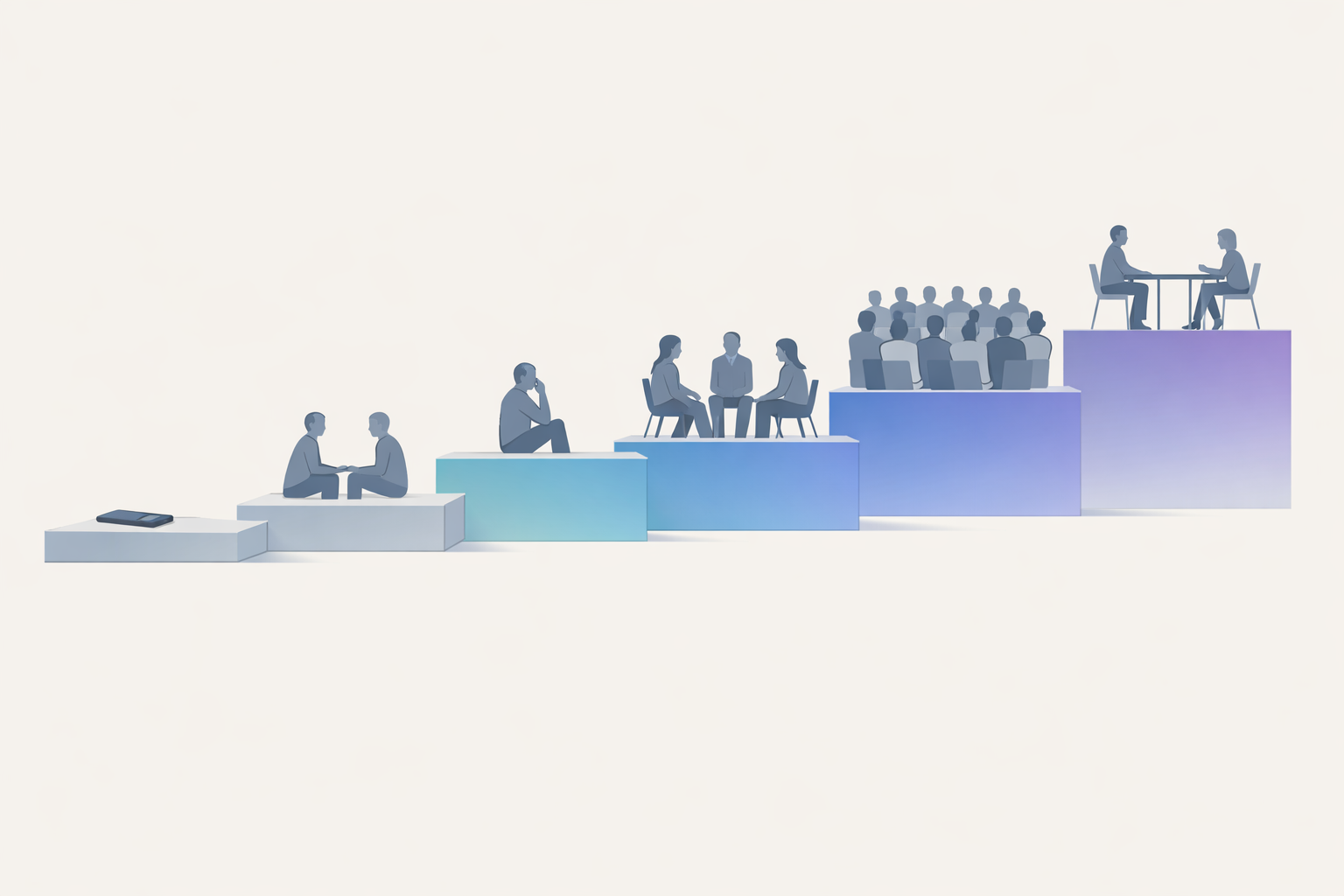
- Alone, with a recorder or an AI listener, nobody present.
- One friend or family member who shares your first language.
- A one-to-one call with a single colleague you trust.
- A small team stand-up where your turn is short and expected.
- A question asked out loud in a large meeting.
- A presentation, or speaking in a job interview.
The move-up rule does the work. Stay on a rung until you can do it twice without rehearsing the sentences first. Rehearsal hides whether the situation still frightens you. Two unrehearsed repetitions and you climb; a bad day and you drop one rung, without calling it failure.
How often you climb is a separate question, and two minutes of daily speaking practice covers frequency. If rung one is where you are, practise speaking alone is the how-to.
Tip
Build the ladder from your avoidance ledger, not from your imagination. Every situation on that list already matters to you, so the rungs come out real instead of aspirational.
Why some people jump straight to the hardest conversation
Because for some of them it works, and pretending otherwise would be dishonest. People move abroad, land in English-only meetings in week one, and come out speaking. That path is real and it is fast.
We have no verified source on who it works for, so here is the honest version. Those cases seem to share frequency and a forgiving audience: many ordinary conversations a week with people who are not grading you. Intensity alone is not the same thing. One high-stakes presentation that goes badly hands your nervous system the evidence it was looking for. With daily volume and a forgiving audience, jump. With one important meeting and three weeks, build the ladder.
What a bottom rung looks like when nobody is listening
A bottom rung is a situation with no audience, one thing to fix, and a clear end. That is the design of Two-Minute Speaking: sessions under two minutes, exactly one point per session explained in your own language. Every mistake is logged as a named item in an error ledger across six categories. An item closes only after correct use in separate spaced sessions, three by default, and at most three concepts stay open at once. You start with a placement session in the browser, and the mechanics are on how a two-minute session works.
The limits, plainly. An AI listener is not a person and cannot judge you, which is the point at rung one and the weakness everywhere above it. We have no outcome data, and practising alone does not by itself transfer to a boardroom. The bottom rung is where you start, not where you stay.
Questions people ask about English speaking anxiety
Is English speaking anxiety the same as social anxiety? Not the same construct. Foreign language anxiety is situation-specific rather than a trait, so people without general anxiety can have it. We found no source separating the two diagnostically, so if it follows you into your first language, ask a professional.
Why do I speak English fine alone and go blank with people? Alone, nothing competes for your attention. With a listener, the monitoring runs in parallel and takes the working memory the sentence needed. That is why rung one is a room with nobody in it.
Can you get rid of English speaking anxiety completely? We cannot promise that. The ladder aims at a smaller reaction in situations that used to be impossible, and a perimeter that grows. Some nervousness before a big meeting is normal in any language.
Does practising with an AI help with real conversations? We found no study on AI conversation partners and foreign language anxiety, so we claim no transfer effect. What an AI listener gives you is a no-audience rung with repetitions and correction. Start there, then climb.
How long does it take for speaking anxiety to drop? There is no number we can give you without inventing one. The honest measure is rungs, not weeks: how high you climbed, and whether you did the current rung twice without rehearsing.
Where to start this week
Tip
Write your ladder tonight and pick the rung one below the highest you entered this month. If the bottom rung is a room with nobody in it, start a placement session and it will give you the one thing to say correctly tomorrow.
Leave a Reply