

English speaking practice for job interview prep works best when you stop trying to improve your English overall and start rehearsing a small, closed set of answers out loud. An interview is not an open field. It is roughly eight to twelve answers, nearly all of them drawn from your own CV and the job ad in front of you. Build those answers, say each one into a recording, and fix exactly one named mistake per session. You need no partner for that. You need a deadline, a microphone, and a way to hear yourself.
What does an English job interview actually test?
An English job interview tests how fast you retrieve language on a narrow, predictable set of topics while someone watches. Speech runs in stages. You decide what to say, then formulation “connects [conceptual entities] with the relevant words associated with them to build a syntactic, morphological, and phonological structure”, and then you articulate it (Psychology of Language, LibreTexts/09:_Speaking/9.02:_The_Standard_Model_of_Speech_Production)). When a stage is not automatic, it takes attention you wanted elsewhere. That last sentence is our reasoning from the model, not a measured finding about interviews.
The cost is likely higher in a second language, based on informed opinion from interview-coaching site Talaera rather than peer-reviewed research. Producing language in real time in a second language likely demands more mental resources than doing so in a first language, which may leave less capacity for reading the interviewer and managing nerves. We could not independently reverify this exact wording on the source page (Talaera). The same source argues that pauses from live translation get read as uncertainty about your qualifications. We also found no peer-reviewed study on how interviewers weigh hesitation from non-native candidates. Either way, the target is not better English. It is fewer live decisions when the question lands.
Why rehearsing in your head does not survive the room
Silent rehearsal feels productive. The answer runs smoothly in your head on the bus, and you move on. But the stage that fails you in the room is articulation, and silent rehearsal is the one method that skips it. That follows from the production model above, not from a study of interviews.
Speaking out loud and retrieving from memory is what seems to move. In a small pilot with eight adult A1 learners, mean length of run and articulation rate both improved after spaced retrieval practice, though the source’s exact figures could not be independently verified (Frontiers in Education). The sample was tiny, and the study’s vocabulary measure was not significant. Suggestive, not settled.
Then spread the sessions out. The largest review of the question covered “839 assessments of distributed practice in 317 experiments located in 184 articles” (Cepeda, Pashler, Vul, Wixted and Rohrer). It found that the gap between sessions and the delay before the test jointly decide what you keep. Six short sessions across six days beat one long Sunday, on the same unit as two minutes of speaking a day.
Which questions do you rehearse first?
Start from the set that recurs everywhere, then fill each one with material only you have. Career centres converge on the same core: “Tell me about yourself”, greatest accomplishments, biggest strength and weakness, a time you worked in a team, “Why should we hire you?” (University of Virginia Career Center). Indeed groups its interview questions into the same families, adding motivation, feedback and conflict (Indeed). Build eight to twelve answers, no more:
- Tell me about yourself, in ninety seconds
- Why this role and this company
- Your two strongest skills, one project each
- A problem you solved start to finish
- A disagreement with a colleague
- A failure and what changed after it
- Your questions for them
- Anything the job ad repeats twice
Derive every answer from your own CV. “Managed reporting for three regional teams” is not an answer yet. Spoken, it becomes: “I owned monthly reporting for three regional teams. The data came in late every month, so I built one shared template. After that we closed the month in two days instead of five.” Rehearse that version, because that is the one that has to leave your mouth.
How do you practise speaking when nobody will listen?
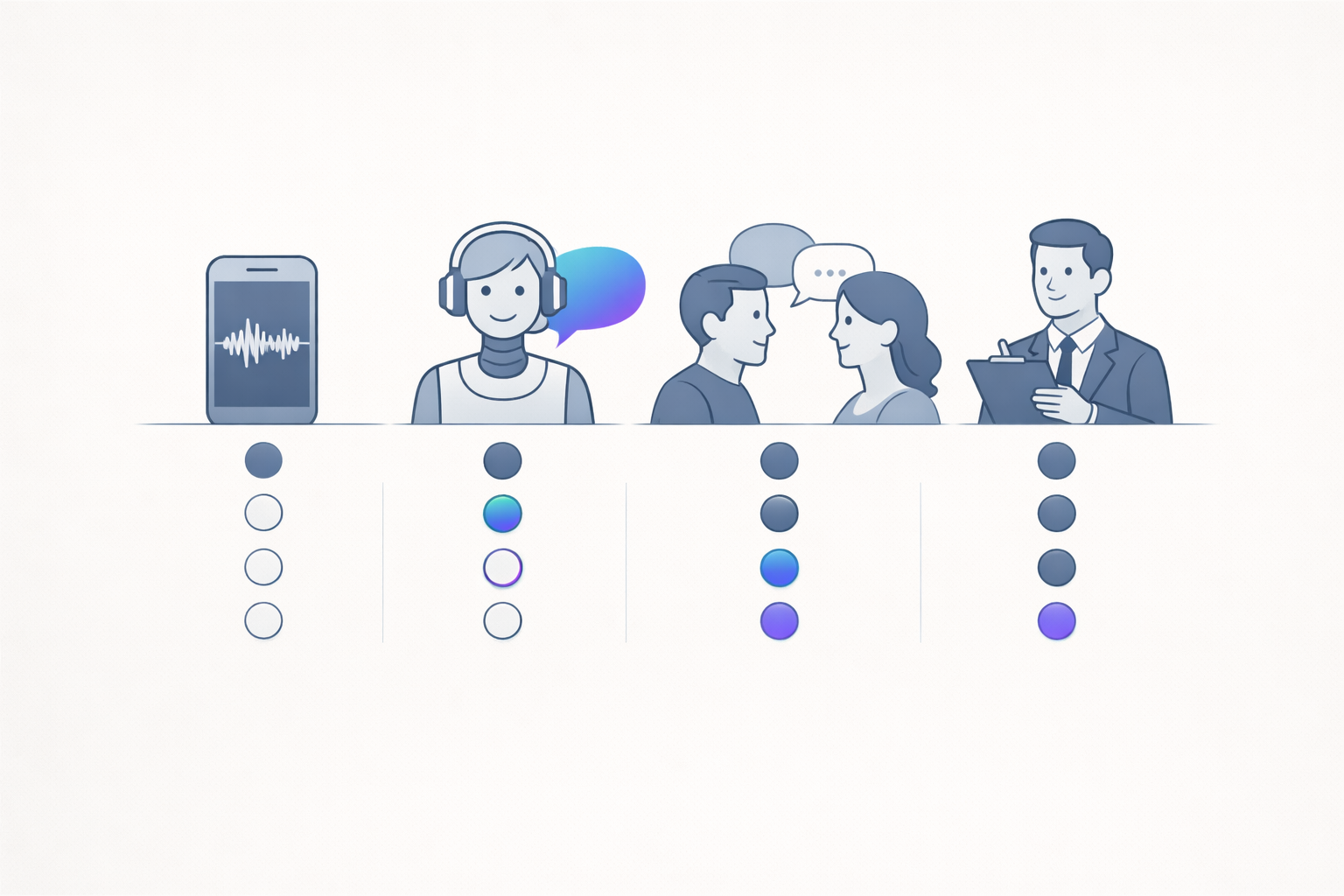
You replace the listener with a recorder, and you accept what each stand-in cannot do. Even the simplest guidance lands there: “use the recording software on your phone or computer to practice reading out the question and then answering it. Play back your recording when you’re done” (EF).
| Stand-in | Gives you | Cannot do |
|---|---|---|
| Voice memo on your phone | Free, instant, honest playback at midnight | Tell you what was wrong |
| AI speaking coach | Correction, prompts you did not choose, spaced review | Reproduce a panel or judge your fit |
| Language-exchange partner | Real reactions and unscripted follow-ups | Correct reliably or show up on demand |
| Paid human mock interview | Closest thing to real pressure, expert feedback | Be repeated daily at a price you will pay |
Two-Minute Speaking sits in the second row, so we will be exact about it. Sessions run under two minutes, and the scenario comes from your own life. The prompt appears in your native language, one point is taught per session, and your mistakes become items in an error ledger with spaced review. It has no published outcome data, and nothing in it decides whether you are offered the job. Without a deadline, practise speaking English alone is the better page for you.
How do you turn one recording into one fixed mistake?
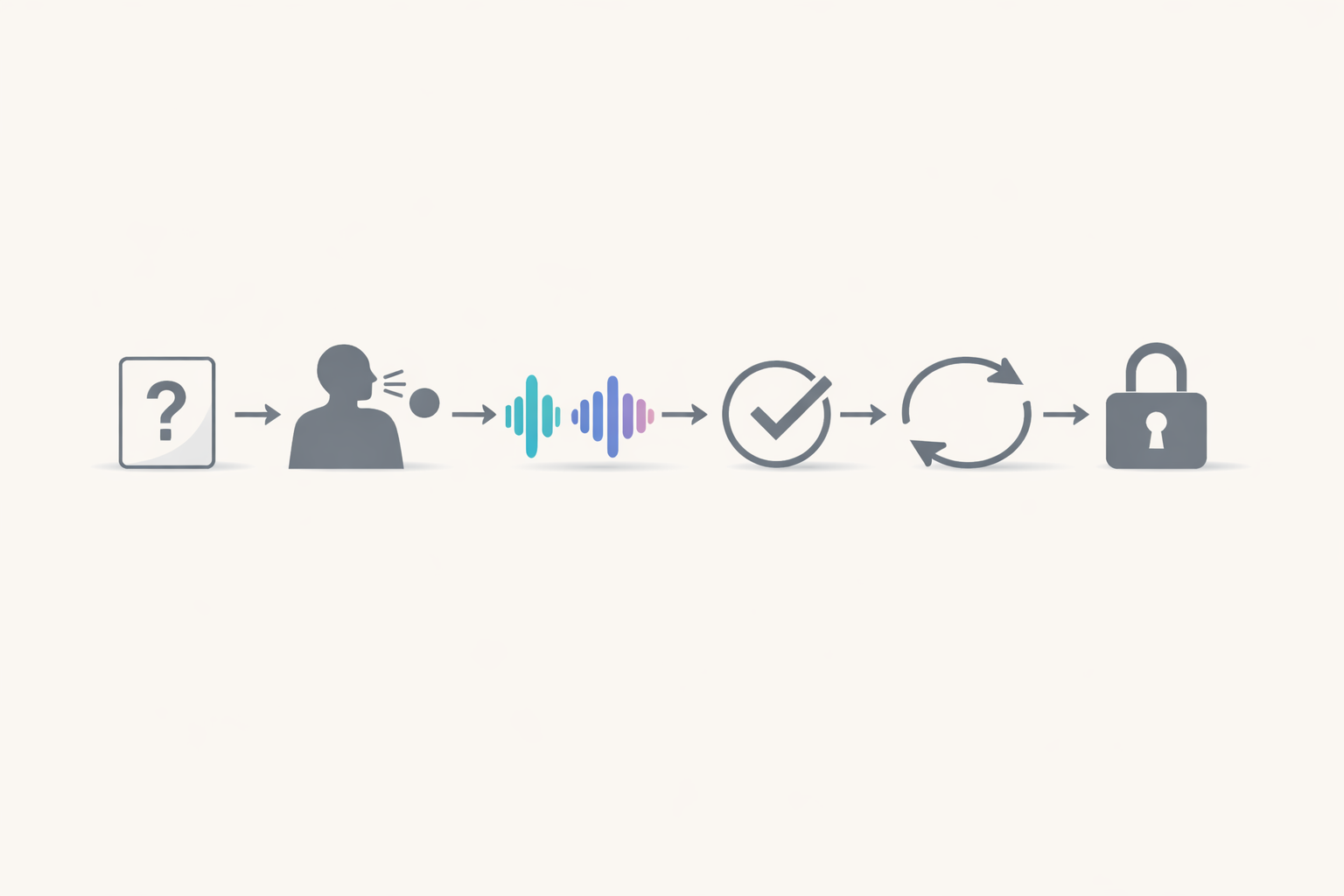
Listening back to yourself is useless without a stopping rule. You will hear twenty problems and fix none of them. Run the 3-2-1 session instead:
- Pull three questions from your own CV or the job ad
- Speak each one for two minutes, recorded, cold, before you read any model answer
- Listen back once and write down one mistake, named in plain words
- Use that item correctly in your next two sessions, then close it
- Keep no more than three items open at the same time
“Named in plain words” is the whole trick. Not “my grammar is bad” but “I said I have problem with the deadline; English wants a problem”. Persian has no articles, so nothing feels missing when you say it (من با او مشکل دارم, man bâ u moshkel dâram). The fix is one word, and one word can be closed. More of them in mistakes Persian speakers make.
Warning
Three correct uses in three separate sessions is a design choice, not a measured threshold. We chose it because it is small enough to finish and slow enough to space out. See how the error ledger closes an item and set your own number.
A three-week rehearsal plan you can compress to four days
No study names how many days before an interview you should start. The spacing evidence supports spreading sessions out rather than cramming, so this calendar is our recommendation, not a research finding.
- Days 1 to 3: write the question list and record cold answers to the first four, polishing nothing
- Days 4 to 10: one 3-2-1 session a day, two new questions and one repeat
- Days 11 to 18: rotate the full set twice and answer your own follow-up questions unprepared
- Days 19 to 20: re-record the four answers you like least and compare them with day one
- Final day: one full pass, then stop
With four days, keep the shape and cut the volume. Day one, build six answers and record them cold. Days two and three, one short session each morning and evening. Day four, one pass and then rest. Six small sessions across four days hold better than one long night.
Tip
In the hour before the interview, speak English out loud for five minutes. Read the job ad aloud, or answer “tell me about yourself” once to the wall. The first question should not also be the first English you have spoken that day.
Why some people still memorise their answers word for word
Every guide says do not memorise, and people memorise anyway, because it works at the moment they are most afraid. A scripted first sixty seconds removes formulation from the hardest minute of the hour. If your fear is going blank on “tell me about yourself”, a memorised opening is a rational trade.
The trade collapses at the first follow-up. With a memorised answer, “the moment the question shifts even slightly, you have nowhere to go and can only deliver what you rehearsed” (CS Insider). Hunting for a line you have lost is the restart loop behind why your sentence stops halfway.
So split the difference. Memorise the first two sentences of your introduction and nothing else. The rest is a pattern you can flex: situation, what you did, what changed. Patterns survive a question you did not expect.
Questions people ask before an English interview
How many days before an interview should I start practising English out loud? No study names a number, so treat any day count as advice rather than evidence. What the spacing research supports is the shape: short sessions across days beat one long session. With two weeks, one 3-2-1 session a day is enough.
How do I know my answer was wrong if nobody corrects me? Record it and listen back once. You will catch most of it yourself: the sentence that restarted, the word you could not find, the tense that slipped. For the rest you need a corrector, which means a tool, a teacher, or a friend who speaks English well.
Should I memorise my English interview answers? Memorise the opening two sentences and leave everything else as patterns. A full script fails the moment the interviewer shifts the question, and interviewers almost always do.
Can an AI app replace a mock interview with a person? No. A person brings unpredictable follow-ups, real social pressure and judgement about your fit. An app brings availability, correction and repetition at a price you will pay every day. If you can afford one human mock interview, do it near the end, after the rehearsal has happened.
What do I do if I go blank in the middle of an answer? Say one honest sentence out loud, such as “let me give you an example instead”, and restart from the example. The silence feels longer to you than to the interviewer. If going blank is your real fear rather than your English, speaking anxiety is the page you want.
Pick one question from the job ad and answer it out loud tonight, before you read anyone’s model answer. If you want the correction and the spacing handled for you, start a two-minute session in Two-Minute Speaking and use your own interview as the scenario.
Leave a Reply